A Pelican panel alternative that runs the same eggs
Pelican keeps Pterodactyl’s design: a PHP panel, plus Wings and Docker on each machine. Zelie runs the same eggs from one Go binary with its own containerd, updates itself from the panel, and runs websites and databases beside the game servers.
Updated November 2026
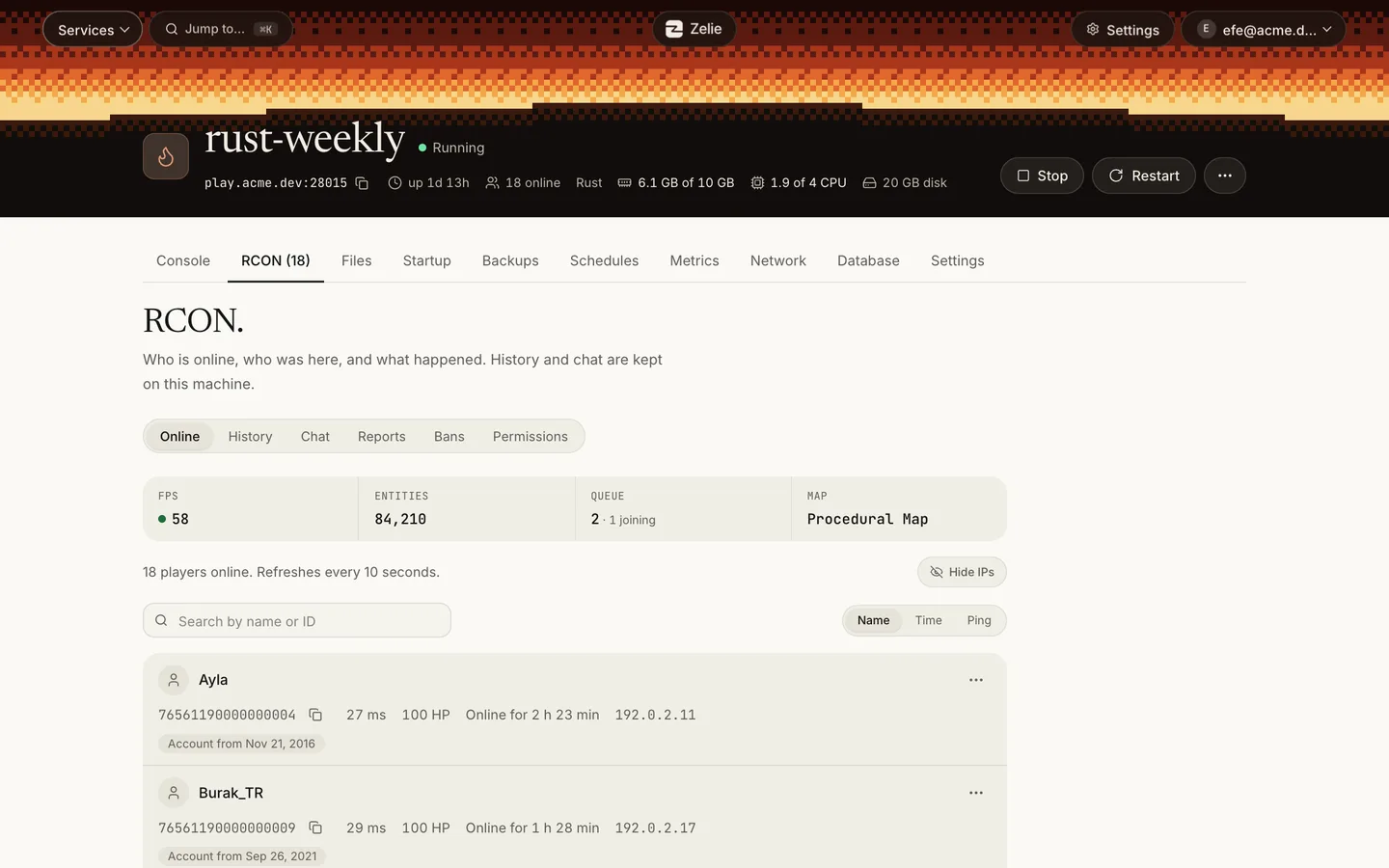
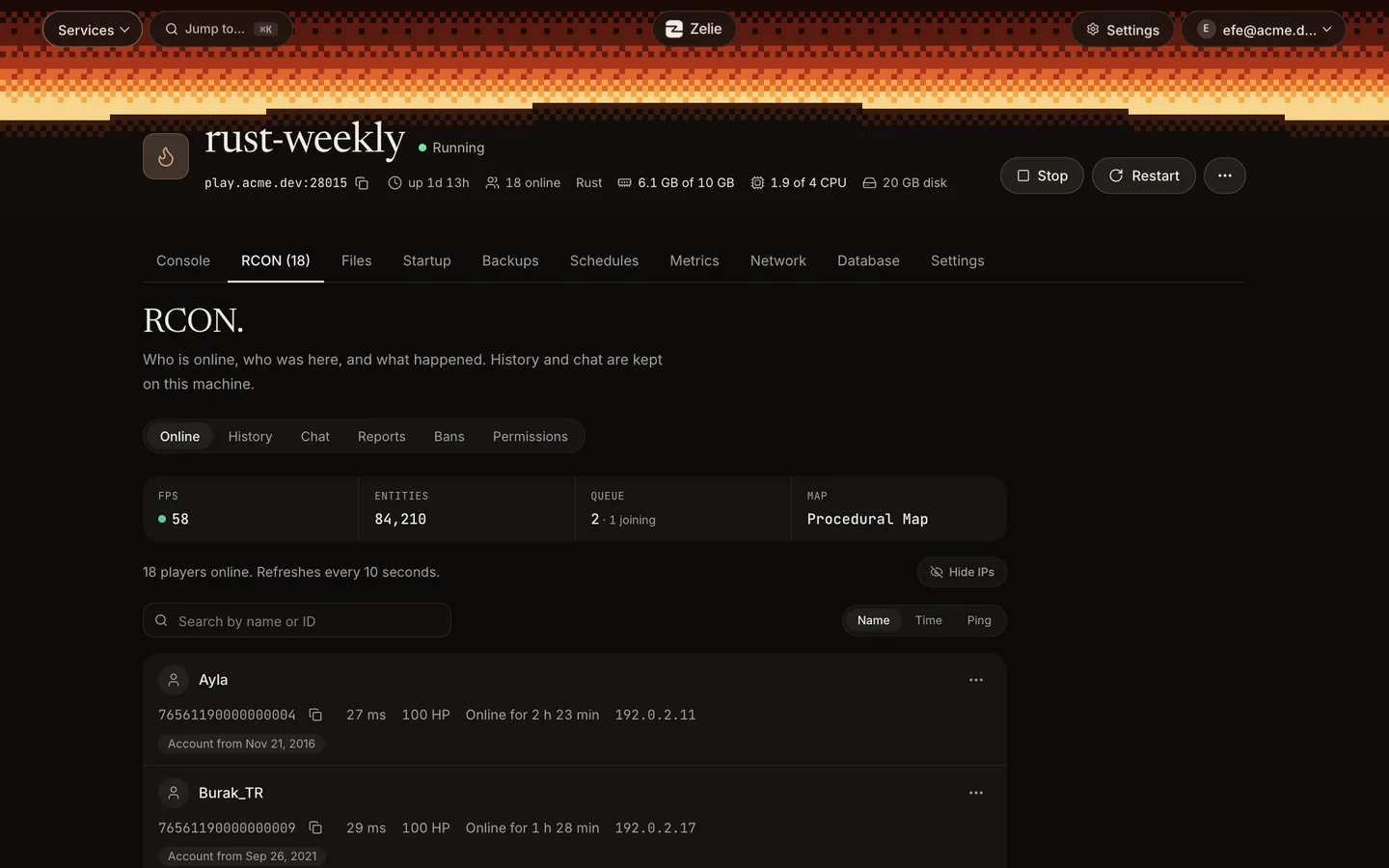
Zelie and Pelican side by side
Install and upkeep
Install
- Zelie
- YesOne command, a few minutes
- Pelican
- PartlyA manual guide
No PHP stack to run
- Zelie
- YesOne Go binary
- Pelican
- NoPHP, Laravel and a web server
Runs without Docker
- Zelie
- YesIts own containerd
- Pelican
- NoWings needs Docker
Updates from the panel
- Zelie
- YesOne click, rolls back by itself if it fails
- Pelican
- PartlyThe panel in one click, since 1.0.0-rc.3 (source)
Security fixes for app packages
- Zelie
- YesEvery night, tested on its own branch first
- Pelican
- NoDoes not look at app packages
Game servers
Pterodactyl and Pelican eggs
- Zelie
- Yes14 games ready, any other by its link
- Pelican
- Yes
Console, files, SFTP, schedules
- Zelie
- Yes
- Pelican
- Yes
Players and RCON tools
- Zelie
- YesRust and Minecraft, a player list for some Steam games
- Pelican
- NoOnly through community plugins
Safe passwords by default
- Zelie
- YesRCON and admin passwords get a random value
- Pelican
- PartlyAs the egg sets them
Steam updates
- Zelie
- YesChecks each hour, updates when nobody plays
- Pelican
- PartlyOn start, if the egg does it
A game server without a public port
- Zelie
- YesReached only from its network group
- Pelican
- PartlyBy hand, without an allocation or on 127.0.0.1 (source)
Minecraft proxy (Velocity) network, set up by the panel
- Zelie
- YesForwarding and its secret, written at each start
- Pelican
- NoNot built in
Says why a server crashed
- Zelie
- YesReads the last lines and names the cause
- Pelican
- PartlyThe same; a community plugin reads logs (source)
Clone a server with its files and settings
- Zelie
- YesA new, stopped server with new ports
- Pelican
- NoOnly a third-party plugin, which copies no files
Apps and databases
Deploy from GitHub on push
- Zelie
- Yes
- Pelican
- No
Deploys without downtime, one-click rollback
- Zelie
- YesLast five versions kept
- Pelican
- No
Automatic HTTPS for apps
- Zelie
- Yes
- Pelican
- No
Databases
- Zelie
- YesPostgreSQL, MariaDB, Redis, with a data browser, linkable to game servers too
- Pelican
- PartlyMySQL for game servers
Browse tables and Redis keys
- Zelie
- YesRead-only, with search and CSV export
- Pelican
- No
Database major-version upgrades from the panel
- Zelie
- YesDumped and loaded; the old volume stays
- Pelican
- NoNot built in (source)
Metrics
- Zelie
- YesRequests, errors, memory and CPU for a day
- Pelican
- PartlyLive memory, CPU and disk I/O (source)
Security
Nothing on the network runs as root
- Zelie
- YesThe root part has no port
- Pelican
- NoWings runs as root on a public port
Private networks between servers
- Zelie
- YesGroups by name, closed to everything outside
- Pelican
- NoThe same model as Pterodactyl (source)
Secrets the panel cannot read back
- Zelie
- Yes
- Pelican
- No
Encrypted backups to S3
- Zelie
- YesEncrypted on the server
- Pelican
- PartlyTo S3, not encrypted
Sub-users with their own permissions
- Zelie
- Yes
- Pelican
- Yes
Coming later
Several machines from one panel
- Zelie
- Planned
- Pelican
- Yes
- Yes
- Partly
- Planned
- No
Pelican is described as it installs by default. Its memory figure was measured by Caria Core on a live server: the panel at about 231 MB and Wings at 38 MB, before the database and Docker.
What Pelican does well
Pelican is made for game servers and does that well. One panel manages many machines, players can get their own access to a single server, and the egg format it uses is the one the game server community writes for. Since 1.0.0-rc.3 its panel updates in one click, and it shows live memory, CPU and disk use. If you need several machines today, stay with Pelican: Zelie does not do that yet.
What Zelie does differently
- One Go binary, no PHP, no Docker. A download of about 50 MB, with its state in SQLite. Its own processes stay under 66 MB of memory when idle, checked in CI on every release.
- One click to update itself. A new release installs from Settings, under General, or in the update round at a time you set. Game servers keep running, and if the new version does not answer within a minute and a half, the old one is put back.
- Root has no port. The part of Zelie that runs as root listens on no network port. Wings runs as root on a public port.
- Players and RCON built in. For Rust and Minecraft: who is online, who was here, chat, kicks and bans, and Minecraft’s whitelist and operators, with nothing extra to install. Pelican has these only through community plugins.
- Says why a server crashed. Zelie reads the last lines and names the cause.
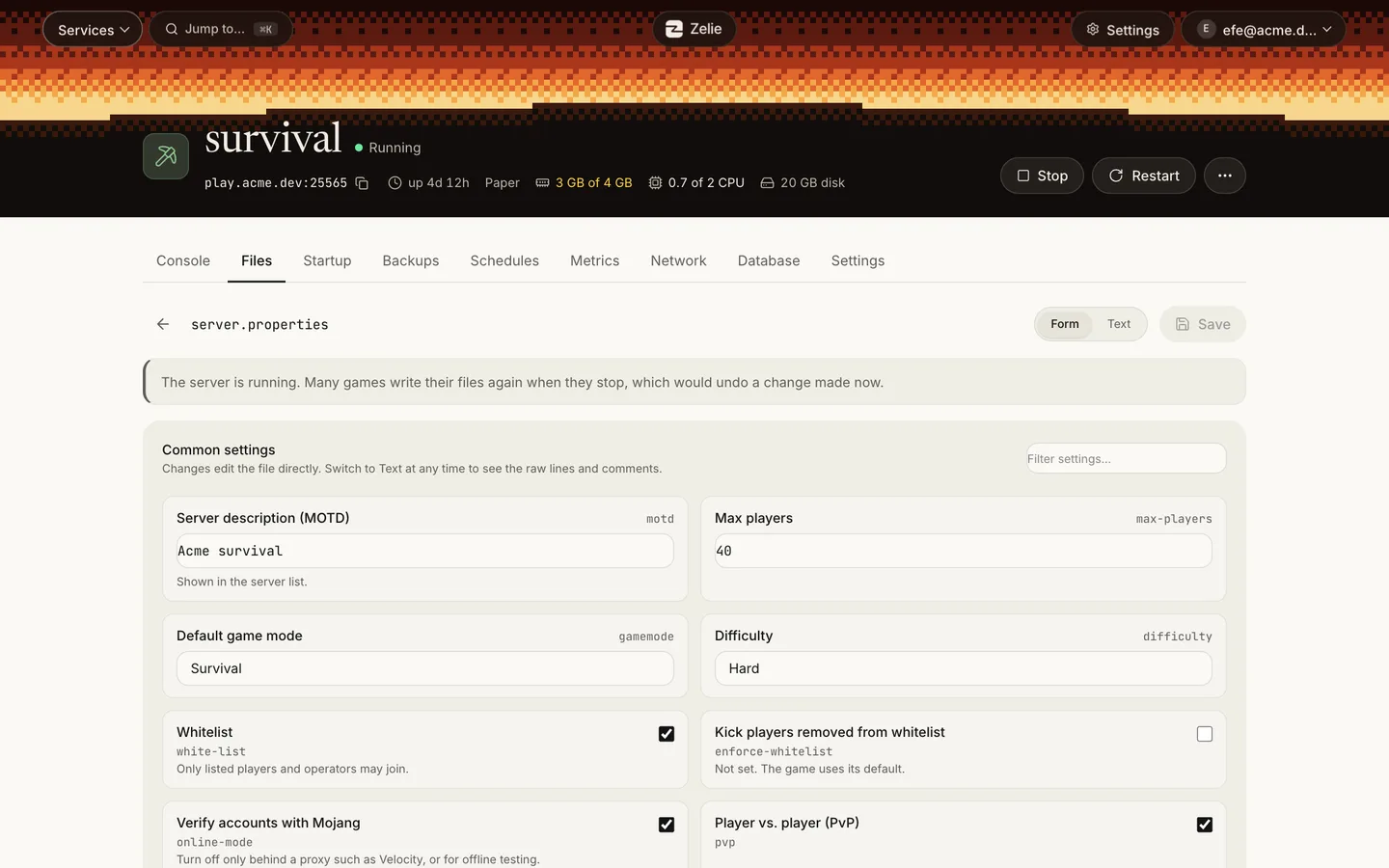
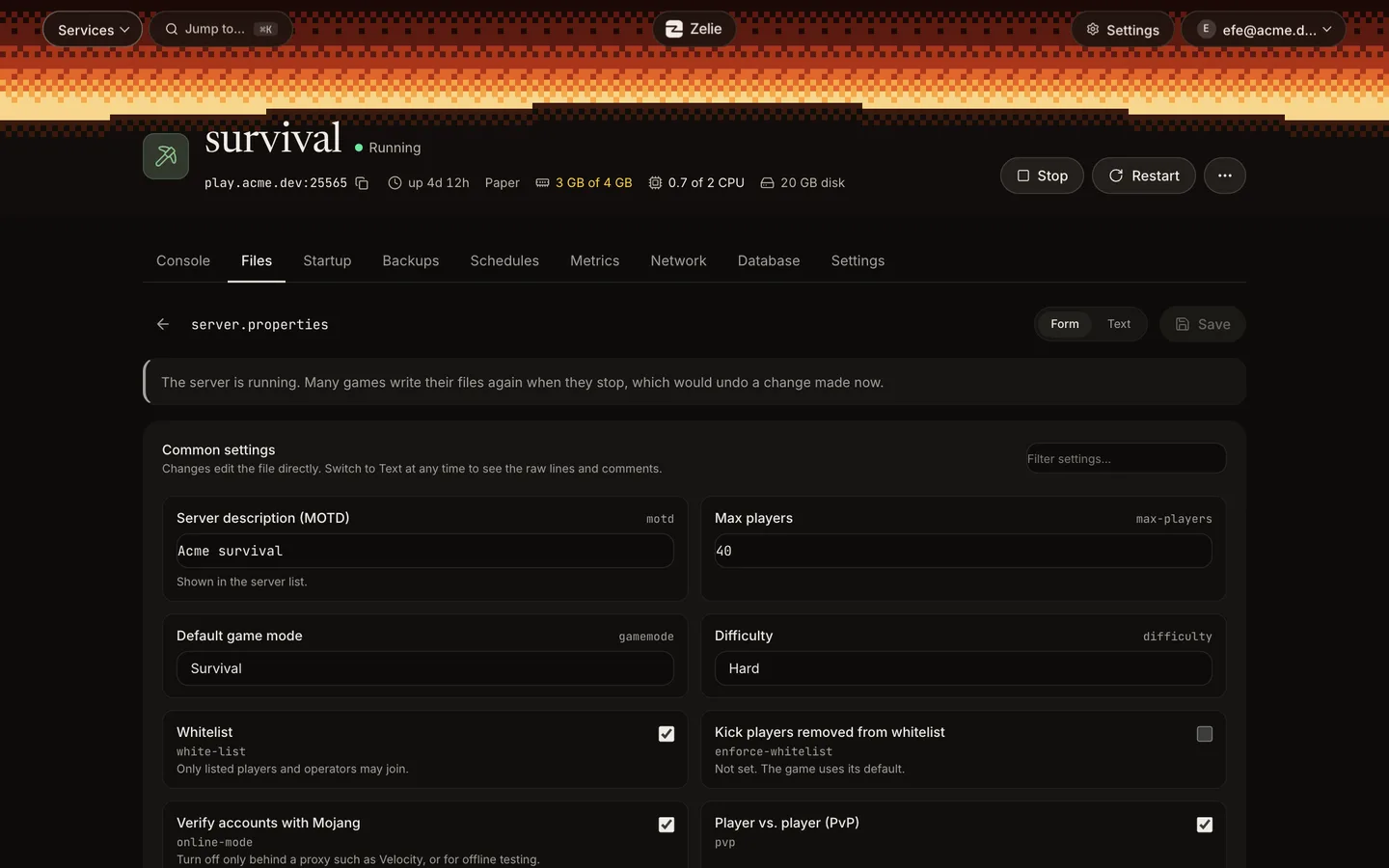
server.propertiesandserver.cfgopen as a form, and a clone copies a server with its files. - Private networks by name. A network group lets servers reach each other by name, closed to everything else. A server can have no public port, and a Velocity proxy can set up its Minecraft network.
- Apps and databases beside the games. Deploy a site or a Discord bot from GitHub with HTTPS, and run PostgreSQL, MariaDB or Redis for it, under the same login.
Moving a server from Pelican
Zelie reads Pelican eggs as they are, and 14 games come from Pelican’s own egg repositories. A server is its egg and its files, so moving one takes a few minutes.
- 1Install Zelie and set up its pool of game ports.
- 2Create the server from the same egg. If it is not in the list, import the egg by its link.
- 3Stop the old server, then download its files over SFTP and upload them to Zelie over SFTP or with the file manager.
- 4Check the startup variables and the ports, then start it.
Both can share a machine while you try: Wings uses port 2022 for SFTP and Zelie 2222. Both want ports 80 and 443 for a domain, so reach Zelie through a Cloudflare Tunnel, and give each panel its own range of game ports.
Questions
Do Pelican eggs work in Zelie?
Yes. Zelie reads eggs in the Pelican and the Pterodactyl format. 14 games are ready to pick, taken from Pelican’s egg repositories, and any other egg can be imported by its link.
Is Zelie a fork of Pelican?
No. It is separate software, written in Go. It reads the egg format Pelican and Pterodactyl use.
Does Zelie support several nodes or sub-users?
Sub-users, yes: invite someone with a link and choose what they may do on each server. Several nodes, not yet: Zelie manages the machine it is installed on, and more than one is planned.
Install Zelie
Zelie is in early development, and Free is open to everyone: make an account and install it on a server of your own. Pro, for your own server too, is on sale now at €4.49 a month or €44.90 a year. Business, for those who sell hosting, follows.